Updated on: 21 Dec 2025, 02:52 PM
Generative AI: What It Is, Why It Matters & How It’s Changing Our World
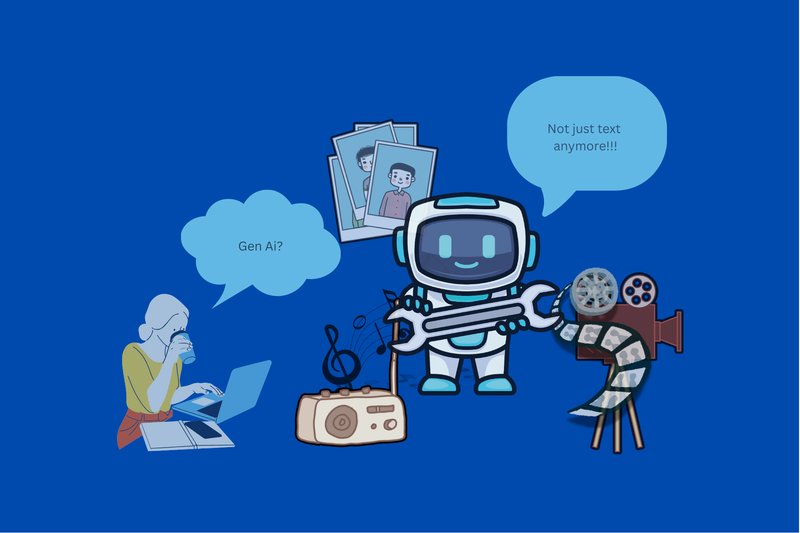
Imagine a machine that doesn’t just follow instructions but creates — crafts images, writes stories, composes music, and even helps scientists spot disease patterns. That’s generative AI. It’s one of the most exciting frontiers in technology today — full of promise, risk, and transformative power.
In this article, we’ll dig into:
-
What generative AI actually is
-
Real-life examples and use cases
-
The data & research behind it
-
Benefits and risks
-
Best practices and what to expect next
By the end, you should have a clear, human sense of how generative AI works, why it matters, and how you (or your organization) can engage with it responsibly.
What Is Generative AI?
At its core, generative AI refers to systems that can produce new content, based on learning patterns from existing data. Unlike traditional AI which might classify things (“Is this image a cat?”), generative AI can generate — text, images, audio, code, etc. Think of it like learning the styles and rules, then composing something fresh.
Some key concepts:
-
Training data: Massive datasets of text, images, audio. The model “learns” by finding patterns.
-
Generative models: Examples include GANs (Generative Adversarial Networks), VAEs (Variational Autoencoders), and large language models (LLMs) like GPT-4, Claude, etc.
-
Prompting: The way humans interact with generative models — by giving them inputs (“prompts”) and asking them to produce something.
How Generative AI Is Already Being Used: Real-Life Examples
To move beyond abstract ideas, here are some concrete, research-backed examples and use cases.
Research & Science
-
A paper published in arXiv studied how generative AI (specifically Claude 3 Opus) can help with research data processing, such as extracting plant species names from historical seed lists or parsing drug names, effectiveness, cost-effectiveness from health technology assessment documents. arXiv
-
Another study compared human creativity vs. AI chatbots, and found there was no qualitative difference in many cases. AI models are proving themselves as productive assistants in creative tasks. arXiv
Industry & Business
-
According to Salesforce’s recent research, 70% of non-users of generative AI say they would use it more if they understood the technology better; 64% if it were more safe and secure. Salesforce
-
In marketing: many marketers are already using generative AI for basic content creation, writing copy, and image generation. It’s not sci-fi; it’s in their daily workflows. Salesforce
Entertainment, Media & Gaming
-
On Steam (the gaming platform), there’s been a nearly 700% year-on-year increase in games that use generative AI for visuals, audio, code or narrative. As of mid-2025, about 7,818 titles (~7% of its full library) disclose GenAI usage. Tom's Hardware
Societal / Predictive Health
-
A recent generative AI tool called Delphi-2M can assess a person’s risk of over 1,000 diseases and forecast long-term health outcomes up to 20 years ahead, based on data like lifestyle, demographics, and medical history. It was tested on huge datasets from the UK Biobank and Danish national registries. The Guardian
These examples show generative AI is more than hype — it is being applied in science, business, creativity, healthcare, and beyond.
The Numbers Behind Generative AI (Data & Research Insight)
| Metric | What It Tells Us |
|---|---|
| Usage | Among “desk workers” surveyed by Salesforce: about 61% currently use generative AI or plan to. Salesforce |
| Trust & Concerns | Over half of users worry about bias, inaccuracy, and security in outputs. Salesforce |
| Demographics | 65% of GenAI users are Millennials or Gen Z; most are employed. Non-users are more from older generations. Salesforce |
| Barriers | Key barriers: concerns over safety/security, lack of training, integration issues, unclear business case. Salesforce |
| Creative performance | In creative tasks like idea generation, AI models often perform comparably to humans in quality (though humans may outperform in subtlety or originality in some cases). arXiv |
Benefits: What Generative AI Brings to the Table
Using evidence and real examples, here are the major advantages of generative AI.
-
Boosted Productivity
Content creation, coding, drafting reports — many tasks that took hours can now be done much faster. Marketers say generative AI gives back ~5 hours per week by automating busy work. Salesforce -
Creativity & Inspiration
Generative AI helps creatives break out of “blank page” syndrome. If you're stuck, getting prompts or rough drafts from a model can spark ideas you wouldn’t have thought of. Research shows AI‐generated ideas often hold up well compared to human ideas. arXiv -
Scalability
Generating images, translations, or personalised messages at scale becomes feasible. For example, with visual content or image assets in gaming environments (as with Steam), or in marketing. Tom's Hardware Salesforce -
Better Decision Making & Predictive Insight
In health, predictive models (like Delphi-2M) allow earlier intervention; in business, GenAI can help with analytic insights on customer data, fraud detection, etc. AIMultiple The Guardian
Risks, Challenges & Common Misconceptions
Like any powerful tool, generative AI has drawbacks. Being aware of them is crucial to using it responsibly.
-
Hallucinations / Inaccuracy: Generative models sometimes produce content that sounds plausible but is false (or “hallucinated”). Fact-checking is essential. Wikipedia
-
Bias: Since models learn from human-created data, they can pick up and amplify biases present in that data.
-
Ethical & Legal Issues: Copyright, intellectual property, privacy — when models generate text or images, who owns them? Is it okay if they imitate style too closely?
-
Data Privacy & Security: Sensitive data leaking via model training or prompts can be a problem.
-
Dependency & Skills Gap: Some people over-rely on generative AI and reduce their own critical thinking or skills. Also, many organizations still lack staff trained to use it well. SF survey shows many marketers don’t know safe use, or how to maximize value. Salesforce
-
Job Disruption Concerns: While many new roles will be created, some jobs will transform or become obsolete. The transition may be difficult for certain sectors or individuals.
Principles & Best Practices: How to Use Generative AI Responsibly
If you’re considering adopting generative AI (for yourself or your organization), here’s a “playbook” based on research and expert practice.
Governance & Oversight
-
Define policies for what can/cannot be generated (e.g. restricted content, sensitive data).
-
Human in the loop: Always have human oversight for critical tasks — health, law, safety, etc.
-
Transparency: Disclose when content is generated, especially for public or legal-use content.
Data & Model Quality
-
Use high-quality, well-labelled training data. Clean data reduces bias and errors.
-
Regularly test and validate generated outputs for correctness, relevance, and fairness.
-
Use synthetic data or augmentation carefully; synthetic images (for example) can help, but have ethical and legal boundaries. arXiv
Safety, Security & Bias Mitigation
-
Restrict access to sensitive datasets; anonymize data.
-
Use bias detection tools and fairness metrics.
-
Monitor for misuse: Deepfakes, disinformation, forged content etc.
Skill Building & Education
-
Train employees or users in prompt engineering, in how to verify outputs, and in the limitations of generative models.
-
Encourage culture of critical thinking — don’t assume AI output is perfect.
Incremental Adoption & Clear Use Cases
-
Start with smaller, low-risk use cases (drafting, internal workflows) before moving to high-stakes areas (medicine, legal, finance).
-
Measure outcomes: time saved, errors prevented, customer satisfaction etc.
Future Trends: What’s Ahead for Generative AI
Looking forward, there are several trends and developments to watch. These aren’t certainties, but they’re grounded in current R&D and industry momentum.
-
Multimodal models that combine text, image, audio, video more fluidly. (E.g. models that can look at images and write stories or generate graphics from text with high fidelity.)
-
Stronger regulation & ethical frameworks, especially in EU, US, India, around copyright, content verification, model accountability.
-
Improved personalization: Generative AI will increasingly adapt to individual users, preferences, style. Think personal AI assistants that know your tone, context.
-
Synthetic data & training: Use of synthetic or generated data to train other systems where real data is scarce or sensitive. But balancing realism, privacy and bias. arXiv
-
Explainability & transparency: Tools to help users understand why a model gave a certain output, not just what output.
-
Broader adoption in non-tech sectors like agriculture, climate modelling, legal services, healthcare diagnostics etc.
Story: How One Small Business Used Generative AI & What Happened
To make it more concrete, here’s a case study with human elements.
Rhea runs a boutique eco-fashion brand in Pune. She was overwhelmed: designing seasonal catalogues, writing social posts, contracting with photographers, and keeping up with customer queries. She decided to experiment with generative AI.
-
First, she used a text-generation model to draft product descriptions, blog posts, and social content.
-
Next, she used an image generator to prototype new print designs and mockups.
-
She then adopted an AI assistant to handle common customer questions.
Outcomes:
-
Time saved: Rhea estimated ~12 hours per week freed up from repetitive tasks.
-
Creativity boosted: Some of the print designs she wouldn't have thought of, but the customers loved them.
-
Challenges: She had to spend time educating herself about prompt design and reviewing AI-generated content for correctness and brand voice. She also found that some generated product descriptions were generic and needed tweaking.
Lesson: Generative AI worked best when seen as a collaborator, not replacement. Human oversight, consistent quality review, and clear branding choices mattered.
Key Takeaways
-
Generative AI = systems that create new content (text, images, etc.) by learning patterns from existing data.
-
Use cases span creative industries, research, healthcare, marketing, gaming etc.
-
Benefits: productivity, creativity, scalability, predictive insight. But major risks: errors, bias, ethics, privacy.
-
Effective use requires governance, oversight, quality data, safety practices, and human review.
-
The future: more multimodal models, regulation, personalization, synthetic data, etc.
Frequently Asked Questions (FAQ)
Q: Is generative AI the same as artificial intelligence?
A: Not exactly. AI is an umbrella term. Generative AI is a sub-field focused on generation of new content, rather than just classification, prediction, or recognition.
Q: Can generative AI replace human creators?
A: Unlikely fully. While it helps with drafts and ideation, brand voice, nuance, ethics, and emotional resonance are still human strengths. Many creative tasks benefit most when humans and AI collaborate.
Q: How accurate are outputs from generative AI?
A: Accuracy varies. For tasks like summarization, extraction, or data-driven prediction, models can be good but also make mistakes. Always verify, especially in high-stakes areas like health or legal.
Q: What are ethical concerns around generative AI?
A: Key concerns: copyright infringement (if model training data is copyrighted), deepfakes or misinformation, bias in generated outputs, privacy of personal data, and misuse.
Conclusion
Generative AI is one of the defining technologies of our time. It holds the potential to change how we work, create, research, and live. But like all powerful tools, its value depends on how we apply it.
If you’re stepping into the world of generative AI — whether as a creator, business owner, researcher or just curious — approach it with optimism and caution. Learn the strengths, respect the risks, build with purpose, and always keep humans in the loop. That’s how we’ll get the benefits — without letting the drawbacks take over.
Related articles
-
AI in content creation
-
What Is Prompt Engineering and Why It Matters in AI Communication
-
Quantum Computing