Updated on: 28 Feb 2026, 06:13 AM
Augmented Reality (AR) & Virtual Reality (VR): A Deep Dive into the Future
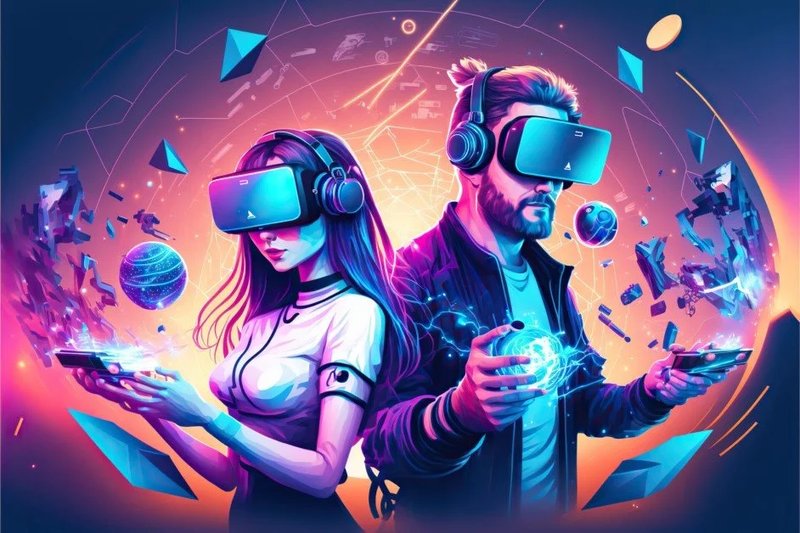
Imagine putting on a headset, stepping into a different world—or seeing holograms projected on your desk while still being very aware of your real surroundings. That’s the magic (and the promise) of Augmented Reality and Virtual Reality. These technologies are transforming how we learn, work, play—and even connect with others.
In this article, you’ll learn:
-
What AR and VR are (and how they differ)
-
Key trends & numbers (market size, user behavior)
-
Real-life applications with vivid examples
-
Benefits, challenges, and expert insights
-
What the future holds & how to prepare
Let’s jump in.
What Are AR & VR?
What is Virtual Reality (VR)?
Virtual Reality is the technology that immerses your senses in a completely computer-generated environment. You put on a VR headset, and everything you see, hear (and sometimes feel) comes from digital simulation. The real world is shut out.
Think of it like being transported somewhere else—maybe a distant planet, a virtual classroom, or a 3D simulation of complex machinery. VR has been used for gaming, simulation training, therapy, virtual travel, etc.
What is Augmented Reality (AR)?
Augmented Reality overlays digital content onto the real world. So instead of shutting out reality, AR enhances it. With AR, you still see your surroundings; the technology adds virtual objects, info, or interactions.
Examples: smartphone apps that overlay furniture in your room, heads-up displays in vehicles, AR filters on social media, or smart glasses projecting info while you walk or work.
Key Differences: AR vs VR vs Mixed Reality
| Feature | AR | VR |
|---|---|---|
| Reality vs Virtual | Real world + digital overlay | Fully virtual environment |
| Immersion | Partial (you see real world) | Full (real world blocked out) |
| Use-cases | Navigation, training in real context, overlaying info | Simulations, immersive entertainment, fully virtual learning |
| Hardware | Smartphones, tablets, AR glasses, head-mounted displays | VR headsets, sometimes with haptics/controllers |
Also, there’s Mixed Reality (MR)—a hybrid where virtual objects are not just overlaid but interact contextually with the real environment in more immersive ways. MR blurs the boundary. MR is often grouped with extended reality (XR). Wikipedia+1
Market Trends & Statistics: Where AR & VR Stand Today
To make sense of AR/VR, it helps to look at data. What’s growing, who’s adopting, where’s the money going?
The Growth Numbers
-
In 2024, global shipments of AR/VR headsets rose ~10% after two years of decline, partly driven by Meta, Apple, and new entrants. IDC
-
The AR & VR market (often grouped as extended reality) was valued at USD 32.1 billion/year as of 2024, with projections to grow almost two-fold by 2028 (to ~USD 50-60+ billion). Exploding Topics+1
-
The XR market (including MR) is forecasted to reach around USD 519.5 billion by 2032, expanding at a CAGR of ~30.8%. Market.us Scoop
Who’s Using AR & VR, and How
-
Nearly 39% of consumers say they have used AR; ~42% have used VR. But about half of people have never used either. TEAM LEWIS
-
Gen Z and Millennials are early adopters. ~63% of Gen Z have used AR; over half of Millennials have used VR. TEAM LEWIS
-
Top use-cases: gaming (54% of users), entertainment (35%), and fitness/wellness (28%) among those who’ve tried AR/VR. TEAM LEWIS
Market Drivers & Hurdles
-
Vehicle displays, enterprise training, educational content, smart glasses are pushing demand. IDC+1
-
Key challenges: device cost, user comfort, content availability, privacy/security concerns. TEAM LEWIS+1
Real-Life Applications & Examples
Understanding AR/VR through stories brings it to life. Here are compelling examples across industries.
Education & Learning
AR turns textbooks into interactive experiences. For example, imagine a biology class: instead of looking at 2D diagrams of the human heart, students use AR apps or headsets to view a 3D beating heart overlaid on their desk. They can rotate it, see inside chambers, understand blood flow.
In many schools, ClassVR and similar platforms are bringing multi-sensory learning. AR/VR helps teach complex anatomical models, physics simulations, historical reconstructions. This leads to better retention and engagement. ClassVR+1
Enterprise Training & Skill Development
Companies are using VR to train employees in hazardous environments—oil rigs, chemical plants, or medical emergency simulations. AR is used to overlay instructions directly onto machinery for maintenance or assembly, reducing error rates and speeding up onboarding. HQSoftware
For instance, an automotive manufacturer might use AR glasses to guide workers on complex engine assembly, overlaying step-by-step instructions so they don’t have to refer to manuals. Mistakes drop, speed increases.
Retail, Marketing & Customer Experience
Retailers are among the pioneers of AR in everyday life:
-
IKEA lets customers use AR apps to visualize furniture in their living spaces.
-
Beauty brands (Sephora etc.) allow virtual try-on of makeup products.
These experiences help reduce purchase hesitation, returns, and enhance customer satisfaction. AR-driven shopping is shown to increase the time customers spend interacting with the brand, and often encourage them to spend more. Exploding Topics+1
Healthcare & Medicine
-
AR has been used in surgery to overlay medical imaging (e.g. MRI scans) onto the patient, helping doctors see inside tissues.
-
VR is used for therapy: treating phobias, post-trauma exposure, and pain management.
These tools are not just futuristic—they’re saving lives and improving outcomes.
Entertainment & Gaming
Obviously this is a big one. VR games (Beat Saber, Half-Life: Alyx, etc.) offer experiences that feel very immersive. AR games like Pokémon Go show how powerful AR on mobile devices can be—combining location data, social interaction, and real-world overlay.
Even concerts, virtual tourism, and storytelling are using VR and AR to craft experiences that were not possible before (e.g. virtual museums, immersive theatre).
Benefits & Challenges
Any emerging tech has its upsides and downsides. Let’s explore both—so you can see what’s realistic and what to watch out for.
Benefits of AR & VR
-
Immersive learning & retention: Studies show learning by doing (through simulations, interactive environments) helps understanding and long-term memory. AR/VR leverages sensory engagement in a way traditional methods can’t. HQSoftware+1
-
Reduced risk in high-stakes training: You can simulate dangerous or expensive operations without real consequences (e.g. flight simulation, medical procedures, industrial safety training).
-
Better customer engagement and decision making: AR allows customers to see what they’re buying in context (your home, body, surroundings), reducing uncertainty.
-
Accessibility & scalability: Once hardware/software is in place, content can be distributed broadly. Remote classes, remote collaboration become easier.
-
Innovation across industries: Architecture, real estate, tourism, automotive, retail—all finding new workflows and revenue streams with AR/VR.
Challenges & Limitations
-
Cost of hardware & content creation: Good VR headsets or AR glasses are expensive. High-quality 3D content and software also take time and money.
-
User comfort & health issues: Some people experience motion sickness, eye strain, or discomfort. “Vergence-accommodation conflict” is one such issue in fixed-focus VR/AR displays. Wikipedia
-
Content & interoperability: Not enough high-quality, universally compatible content. Fragmented platforms make it hard for creators.
-
Privacy & security risks: AR/VR devices collect more personal, spatial, behavioral data than many other devices. Policies are improving but concerns remain. arXiv+1
-
Social & psychological implications: Overuse, disconnection from real world, potential for addiction, or impact on mental health are non-trivial.
Expert Insights: What Thought Leaders Say
It helps to hear ambitions and concerns from people working on the cutting edge.
-
Tim Cook (Apple) has said: “I’m excited about augmented reality because unlike virtual reality, which closes the world out, AR allows individuals to be present in the world but hopefully allows an improvement on what’s happening presently.” Bernard Marr+1
-
Satya Nadella described AR as “perhaps the ultimate computer.” Medium+1
-
Mark Zuckerberg, speaking of AR’s future, said that many items we consider physical objects may become digital apps in an AR app store in the future. Medium+1
These leaders see AR/VR not just as gadgets, but as platforms that could change what “computing” means, what “work” means, what “social interaction” means.
Future Outlook: What’s Coming Next
What should you watch if you care about AR/VR—whether as a user, business, educator, or investor?
Trends That Will Shape the Next Years
-
AI + AR/VR convergence: Smarter content generation, voice & gesture control, adaptive environments.
-
More affordable, lighter, sleeker hardware: Smart glasses that look like regular glasses; lighter headsets.
-
Better battery life and display tech: Higher resolution, less latency, more natural interactions.
-
Mass deployment in enterprise & education: As ROI improves, more organizations will adopt AR/VR for training, remote collaboration, process improvements.
-
Immersive social and remote experiences: Think virtual offices, remote concerts, shared VR spaces.
Projections & Data
-
Shipments of AR/VR headsets are projected to rise steeply; demand for AI-enabled and lower-cost devices is a key factor. Reuters+1
-
By 2032, extended reality (XR) market size could cross USD 500 billion globally. Market.us Scoop
How to Leverage AR/VR: Practical Tips for Businesses & Individuals
If you’re considering using AR/VR (for learning, business, entertainment), here are actionable suggestions to get started smartly.
-
Start small, test often
Pilot projects (for training, customer experience) help you test ROI without heavy upfront investment. -
Choose the right platform & hardware
Consider the trade-offs: immersive VR vs easier access of mobile AR. Also think about comfort, compatibility, user base. -
Focus on content & UX
A beautiful headset is nothing without good design. Poor UX can break immersion and lead to frustration. -
Prioritize privacy and safety
Transparent data policies, secure storage, giving users control over their data will matter more and more. -
Train people to use it meaningfully
For education or business, having instructors/facilitators who understand how to integrate AR/VR into learning or workflows is critical.
FAQ / Featured Snippet Section
What’s the difference between AR and VR?
Answer:
Virtual Reality (VR) fully immerses the user in a computer-created environment, blocking out the physical world.
Augmented Reality (AR) overlays digital elements on top of the real world, so you still interact with your surroundings but with added virtual content.
What are real-life examples of AR/VR use?
AR examples: furniture apps (IKEA), virtual try-ons, AR navigation.
VR examples: immersive training simulations, VR gaming, virtual tours or therapy.
What are benefits vs challenges of AR/VR?
Benefits: immersive learning, safe simulations, engaging customer experiences, innovation in industry.
Challenges: cost, hardware discomfort, content availability, privacy concerns.
Personal Stories & Case Study
Let me share a story that illustrates how AR changed something in real life.
Case Study: Repairing Heavy Machinery using AR
A manufacturing plant in Europe had frequent downtime due to complex machine maintenance. Engineers needed to look up manuals, follow steps, often cross-check parts. It took hours, mistakes were costly.
They started using AR headsets: when a worker looks at the machinery, overlays show the exact part numbers, steps, even warnings (like which parts are hot). The result: 30–40% reduction in maintenance time, fewer errors, less downtime. Engineers also felt more confident, because they had “hands-free” guidance.
That’s powerful—technology directly improving real work.
Final Thoughts: Is AR/VR Worth It?
Bottom line: Yes, AR and VR are more than hype. They’re already reshaping many fields, and the pace is increasing. But this transformation won’t be uniform—it depends on use-case, investment, content, hardware quality, and ethical/legal frameworks.
If you are a student, business leader, teacher, or creator, now is a great time to explore and experiment. Being an early mover—even on pilot projects—can give you a competitive advantage when the technology becomes as common as smartphones.
Related articles
-
6 Best Smart Glasses of 2025: AR, AI & Portable Cinema in Your Pocket
-
What is Starlink? Everything You Need to Know in 2025
-
5G and Beyond